Youth Pitching Injury Statistics (2026): Tommy John, Arm Pain & Overuse Data
TL;DR: Teenagers make up the majority of Tommy John surgeries: 15- to 19-year-olds accounted for 56.8% of UCL reconstructions in a large U.S. insurance database. The most recent research shows the problem is current: in a 2023 study, 89% of high school pitchers broke at least one Pitch Smart guideline and 65% played for multiple teams, and MLB's 2024 injury report found young pitchers throwing harder, earlier, and more often. Pitching while fatigued remains the single biggest risk factor (about 36 times higher odds of surgery). Every number on this page links to its original source.
This page collects the most important, most-cited research on youth pitching injuries in one place: Tommy John surgery trends, how common arm pain is, the risk factors that matter most, and how often the safety guidelines are actually followed. It's written for parents, coaches, and anyone researching youth baseball arm health. Each statistic includes the study, the year, and who was studied, so you can check it and cite it accurately.
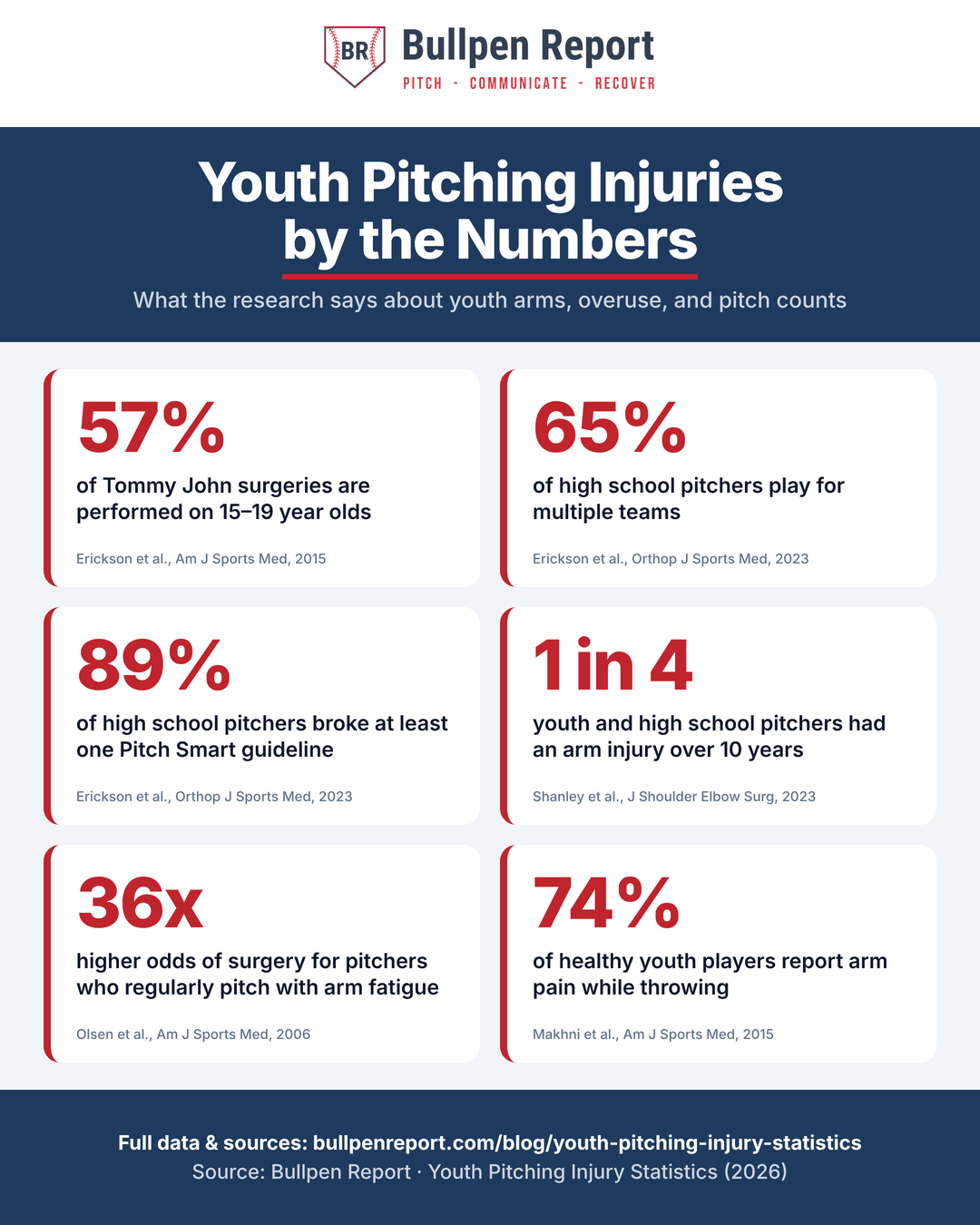
Share this graphic
Free to use on your site, blog, or team page with credit. Copy the code below to embed it with a link back to the full data and sources.
The Latest Research (2023–2026)
- Nearly 9 in 10 high school pitchers break the guidelines. In a multi-state study of 115 high school pitchers completed in 2022, 89% broke at least one Pitch Smart guideline. The most common were not taking 3 straight months off from throwing (67%) and playing for multiple teams (65%). Pitchers who threw harder were more likely to be noncompliant. (Erickson et al., 2023)
- About 1 in 4 pitchers get hurt over a 10-year span. A 10-year study of 261 youth and high school pitchers found about one in four suffered an arm injury, and the risk rose the longer they pitched. (Shanley et al., 2023)
- MLB says young pitchers are throwing harder, earlier, and more often. In its December 2024 report on pitcher injuries, based on interviews with more than 200 experts, MLB found high school pitchers reaching top-end velocities at younger ages and more often than a decade ago, and that data suggests youth and high school pitching injuries are becoming more frequent and severe. The report noted a 9-year-old can throw 115 pitches over four days without violating Pitch Smart, and that one 11U team played 154 games in 2021. It recommended updating Pitch Smart and giving young pitchers more rest, especially during showcase season. (MLB, 2024)
- UCL injuries keep climbing. Outpatient visits for UCL injuries rose 59% among 10- to 39-year-olds from 2016 to 2022, and 15- to 19-year-olds had more UCL repairs and reconstructions than any other age group. (Guy et al., 2026)
The studies further down this page are the landmark research that Pitch Smart and most youth guidelines are built on. They're older, but they remain the most-cited evidence on youth pitching injuries, and the recent studies above point in the same direction.
Key Youth Pitching Injury Statistics at a Glance
56.8%
of UCL reconstructions (Tommy John surgeries) were performed on 15- to 19-year-olds, the largest share of any age group
Source: Erickson et al., 2015
74%
of healthy youth players (ages 8–18) reported arm pain while throwing at some point
Source: Makhni et al., 2015
47%
of youth players said they were encouraged to keep playing despite arm pain
Source: Makhni et al., 2015
36x
higher odds of needing elbow or shoulder surgery for pitchers who regularly pitched with arm fatigue
Source: Olsen et al., 2006
3.5x
higher risk of serious elbow or shoulder injury for pitchers who threw more than 100 innings in a year
Source: Fleisig et al., 2011
83%
of surveyed caregivers of youth pitchers were unaware that safe pitching guidelines existed
Source: Reintgen et al., 2021
Tommy John Surgery Statistics in Youth Baseball
- 15- to 19-year-olds account for the majority of UCL reconstructions. In a U.S. private-insurance database covering 2007–2011, patients aged 15 to 19 made up 56.8% of all UCL reconstructions, more than any other age group, and the rate in that group grew 9.1% per year. (Erickson et al., 2015)
- UCL reconstruction volume nearly tripled in a decade. In New York State, UCL reconstruction volume rose 193% from 2002 to 2011, the population rate tripled, and the procedure became increasingly common in adolescents, with a significant shift toward 17- to 20-year-olds. (Hodgins et al., 2016)
- UCL injuries are still climbing. National outpatient data showed visits coded as UCL injuries rose 59% among 10- to 39-year-olds from 2016 to 2022, and 15- to 19-year-olds had more UCL repairs and reconstructions than any other age group. (Guy et al., 2026)
- About 1 in 20 young pitchers suffer a serious arm injury. In a 10-year study that followed 481 pitchers who started at ages 9 to 14, 5% had an elbow or shoulder injury that led to surgery or retirement from baseball. (Fleisig et al., 2011)
For what UCL surgery involves and how families can lower the risk, see our guide to Tommy John surgery in youth baseball.
How Common Is Arm Pain in Youth Pitchers?
- Most youth players throw through pain. In a survey of 203 healthy players aged 8 to 18, 74% reported arm pain while throwing at some point, 80% reported arm pain the day after throwing, and 82% reported arm fatigue during a game or practice. (Makhni et al., 2015)
- Nearly half are encouraged to keep playing. In the same survey, 47% of players said they had been encouraged to keep playing despite arm pain. (Makhni et al., 2015)
- Half of youth pitchers have arm pain in a single season. In a season-long study of 476 youth pitchers, 50% reported elbow or shoulder pain at least once: 28% reported elbow pain and 35% reported shoulder pain. (Lyman et al., 2002)
- Pitch type matters. In that same study, throwing a slider was linked to an 86% higher risk of elbow pain and throwing a curveball to a 52% higher risk of shoulder pain, while the changeup was linked to lower risk of both. (Lyman et al., 2002)
The Biggest Risk Factors for Youth Pitching Injuries
The research consistently points to the same thing: total workload and pitching tired matter far more than any single game. Here are the most cited risk factors, with the size of each effect as reported by the original study.
| Risk factor | Reported effect | Source |
|---|---|---|
| Regularly pitching with arm fatigue | ~36x higher odds of surgery (OR 36.18) | Olsen et al., 2006 |
| Pitching competitively more than 8 months per year | ~5x higher odds of surgery (OR 5.05) | Olsen et al., 2006 |
| More than 80 pitches per game | ~4x higher odds of surgery (OR 3.83) | Olsen et al., 2006 |
| Fastball velocity over 85 mph | ~2.6x higher odds of surgery (OR 2.58) | Olsen et al., 2006 |
| More than 100 innings pitched in a year | 3.5x higher risk of serious injury | Fleisig et al., 2011 |
| Often pitching with arm tiredness | 7.9x higher odds of a pitching-related injury (OR 7.88) | Yang et al., 2014 |
| Often pitching with arm pain | 7.5x higher odds of a pitching-related injury (OR 7.50) | Yang et al., 2014 |
| Pitching on consecutive days | 2.5x higher odds of arm pain (OR 2.53) | Yang et al., 2014 |
| Pitching more than one game in a day | 1.9x higher odds of arm pain (OR 1.89) | Yang et al., 2014 |
| Pitching for multiple teams with overlapping seasons | 1.9x higher odds of arm pain (OR 1.85) | Yang et al., 2014 |
How to read this table: "OR" is an odds ratio. Olsen et al. compared 95 adolescent pitchers who had elbow or shoulder surgery with 45 who hadn't, so its numbers describe how much more likely surgery-group pitchers were to have each factor. Yang et al. surveyed 754 youth pitchers at one point in time. Both studies show strong associations, not proof of cause and effect, but the pattern across studies is consistent.
Multi-Team Play and Scheduling Statistics
- Most high school pitchers play for more than one team. In a 2023 multi-state study of 115 high school pitchers, 65% played for multiple teams, and 67% didn't take 3 straight months off from throwing. (Erickson et al., 2023)
- Nearly 1 in 3 younger pitchers play for overlapping teams. In a national survey of 754 pitchers aged 9 to 18, 30.7% had pitched for multiple teams with overlapping seasons in the past 12 months. (Yang et al., 2014)
- Back-to-back days are common. In the same survey, 43.4% had pitched on consecutive days and 19.0% had pitched in more than one game on the same day. (Yang et al., 2014)
- Many caregivers report concurrent leagues. In a survey of caregivers of youth pitchers aged 7 to 18, 44% said their child played in multiple leagues at the same time, 58% had attended showcases, and 18% pitched at least 9 months a year. (Reintgen et al., 2021)
Multi-team play matters because pitch counts and rest days apply to the player, not the team. Two coaches can each follow the rules and still overwork the same arm. We cover how that happens in our tournament weekend guide.
Pitch Count Guideline Awareness and Compliance
- 89% of high school pitchers break at least one guideline. In the 2023 multi-state study, 84% reported breaking at least one guideline in a preseason survey (most often skipping the 3 months of rest or playing for multiple teams), and 14% of pitchers whose pitch counts were tracked in-season went over a limit at least once. (Erickson et al., 2023)
- Over 90% of teams break the guidelines. In a study of 100 youth tournament teams (8U through 14U) across nearly 2,500 games in summer 2019, more than 90% of teams violated Pitch Smart guidelines at least once, and 48.6% of pitchers were used in at least one way that violated them. The youngest age group, 8U, had the most violations. (Greiner et al., 2021)
- Most caregivers don't know the guidelines exist. In a survey of 98 caregivers of youth pitchers, 83% were unaware of safe pitching guidelines and 53% did not actively monitor their child's pitch count. (Reintgen et al., 2021)
- Many leagues don't enforce limits. In the national survey of 754 youth pitchers, 44.3% had pitched in leagues without pitch count or innings limits in the past year. (Yang et al., 2014)
What the Guidelines Recommend
Pitch Smart's pitch count and rest tables were last updated for the 2018 season, and MLB's 2024 injury report recommended updating them again. Until that happens, these are the standards most leagues follow.
MLB and USA Baseball's Pitch Smart guidelines draw on this research. The core recommendations for youth pitchers:
- Annual innings: no more than 80 innings in any 12-month period for ages 9–12, and no more than 100 for ages 13–18.
- Time off: at least 4 months off from throwing (or competitive pitching, for ages 15–18) every year, including 2–3 continuous months.
- Consecutive days: no pitcher should appear in a game on three consecutive days, regardless of pitch count, and no pitching in multiple games on the same day.
- Multiple teams and positions: avoid playing for multiple teams at the same time, and avoid playing catcher while not pitching.
- Daily limits and rest: daily pitch maximums range from 50 (ages 7–8) to 105 (ages 17–18), with required rest days based on how many pitches were thrown. See the full rest-day chart and daily limits by age.
What These Numbers Mean for Parents and Coaches
The pattern across 20 years of research is clear. Serious injuries are tied to cumulative workload and pitching tired, and the guidelines that address both are widely ignored or unknown. The gap is biggest for kids who pitch for more than one team, because no single coach sees the full workload.
That's the problem Bullpen Report was built to solve: one pitch count and rest-day record per pitcher, shared across every team he plays for, so every coach can see the whole picture. See how Bullpen Report tracks pitch counts across teams.
FAQ
What percentage of Tommy John surgeries are performed on teenagers?
In a large U.S. private-insurance database study covering 2007 to 2011, patients aged 15 to 19 accounted for 56.8% of all UCL reconstructions (Tommy John surgeries), more than any other age group, and the rate in that age group grew 9.1% per year (Erickson et al., 2015).
How common is arm pain in youth baseball players?
Very common. In a survey of 203 healthy players aged 8 to 18, 74% reported arm pain while throwing at some point and 80% reported arm pain the day after throwing. 47% said they had been encouraged to keep playing despite arm pain (Makhni et al., 2015).
What is the biggest risk factor for youth pitching injuries?
Pitching while fatigued. Adolescent pitchers who regularly pitched with arm fatigue were about 36 times more likely to be in the group that needed elbow or shoulder surgery. Pitching more than 8 months a year (about 5 times) and more than 80 pitches per game (about 4 times) were also strongly linked to surgery (Olsen et al., 2006).
How often do youth baseball teams follow Pitch Smart guidelines?
Rarely. In a 2023 multi-state study of 115 high school pitchers, 89% broke at least one Pitch Smart guideline, most often by not taking 3 straight months off from throwing (67%) or by playing for multiple teams (65%) (Erickson et al., 2023). A study of 100 youth tournament teams (8U to 14U) found more than 90% of teams violated the guidelines at least once (Greiner et al., 2021).
How many youth pitchers play for more than one team?
In a 2023 multi-state study of 115 high school pitchers, 65% played for multiple teams (Erickson et al., 2023). In an earlier national survey of 754 youth pitchers aged 9 to 18, 30.7% had pitched for multiple teams with overlapping seasons in the past year, which was associated with higher odds of arm pain (Yang et al., 2014).
Sources
- Erickson BJ, et al. Trends in Medial Ulnar Collateral Ligament Reconstruction in the United States: A Retrospective Review of a Large Private-Payer Database From 2007 to 2011. American Journal of Sports Medicine. 2015. Link
- Hodgins JL, et al. Epidemiology of Medial Ulnar Collateral Ligament Reconstruction: A 10-Year Study in New York State. American Journal of Sports Medicine. 2016. Link
- Guy CR, et al. Incidence of Elbow Medial Ulnar Collateral Ligament Repair and Reconstruction: A US Population Database Study 2016 to 2022. Orthopaedic Journal of Sports Medicine. 2026. Link
- Erickson BJ, et al. Characteristics Associated With Noncompliance of Current Pitch Smart Guidelines in High School Baseball Pitchers Throughout the United States. Orthopaedic Journal of Sports Medicine. 2023. Link
- Shanley E, et al. Arm Injury in Youth Baseball Players: A 10-Year Cohort Study. Journal of Shoulder and Elbow Surgery. 2023. Link
- Major League Baseball. Report on Pitcher Injuries. December 2024. Link
- Fleisig GS, et al. Risk of Serious Injury for Young Baseball Pitchers: A 10-Year Prospective Study. American Journal of Sports Medicine. 2011. Link
- Olsen SJ, et al. Risk Factors for Shoulder and Elbow Injuries in Adolescent Baseball Pitchers. American Journal of Sports Medicine. 2006. Link
- Yang J, et al. Risk-Prone Pitching Activities and Injuries in Youth Baseball: Findings From a National Sample. American Journal of Sports Medicine. 2014. Link
- Makhni EC, et al. Arm Pain in Youth Baseball Players: A Survey of Healthy Players. American Journal of Sports Medicine. 2015. Link
- Lyman S, et al. Effect of Pitch Type, Pitch Count, and Pitching Mechanics on Risk of Elbow and Shoulder Pain in Youth Baseball Pitchers. American Journal of Sports Medicine. 2002. Link
- Greiner JJ, et al. Pitching Behaviors in Youth Baseball: Comparison With the Pitch Smart Guidelines. Orthopaedic Journal of Sports Medicine. 2021. Link
- Reintgen C, et al. Youth Baseball Caregiver Understanding of Safe Pitching Guidelines. International Journal of Sports Physical Therapy. 2021. Link
- MLB and USA Baseball. Pitch Smart Pitching Guidelines. Link
How to cite this page
Bullpen Report. "Youth Pitching Injury Statistics (2026)." Updated October 2026. https://www.bullpenreport.com/blog/youth-pitching-injury-statistics
When citing a specific statistic, please also cite the original study linked next to it.
Medical disclaimer
This page summarizes published research for general educational purposes only and is not medical advice. It isn't a substitute for guidance from a physician, athletic trainer, or physical therapist who knows your player. If your player has elbow or shoulder pain that doesn't go away, swelling, numbness, tingling, or a sudden loss of velocity or control, stop throwing, rest, and see a qualified medical professional before he returns to pitching.
Track your pitcher's pitch counts across all his teams.
Written by the Bullpen Report team. Bullpen Report is a youth baseball arm health platform built by coaches and parents, for coaches and parents.